---
title: "Beyond the Walk: When the Electric End-Rider Pallet Jack Becomes Essential | Equipment Depot"
description: As throughput demands continue to soar, the electric rider pallet truck is a crucial piece of material handling equipment in high-volume logistics.
image: https://blog.eqdepot.com/hubfs/12020034%20-%20narrow.jpg
---
HOME I EQDEPOT.COM
[](https://www.eqdepot.com)
- [ALL POSTS](https://blog.eqdepot.com)
- [FORKLIFTS](https://blog.eqdepot.com/topic/forklifts)
- [AERIAL LIFTS](https://blog.eqdepot.com/topic/aerial-lifts)
- [RENTALS](https://blog.eqdepot.com/topic/rentals)
- [SAFETY & TRAINING](https://blog.eqdepot.com/topic/safety-training)
- [SERVICE & SUPPORT](https://blog.eqdepot.com/topic/service-support)
- [HOME](https://blog.eqdepot.com)
- [EQDEPOT.COM](https://www.eqdepot.com)
This is a search field with an auto-suggest feature attached.
- There are no suggestions because the search field is empty.
# WHEN SHOULD I upgrade to an end-rider pallet jack?
December 17, 2025
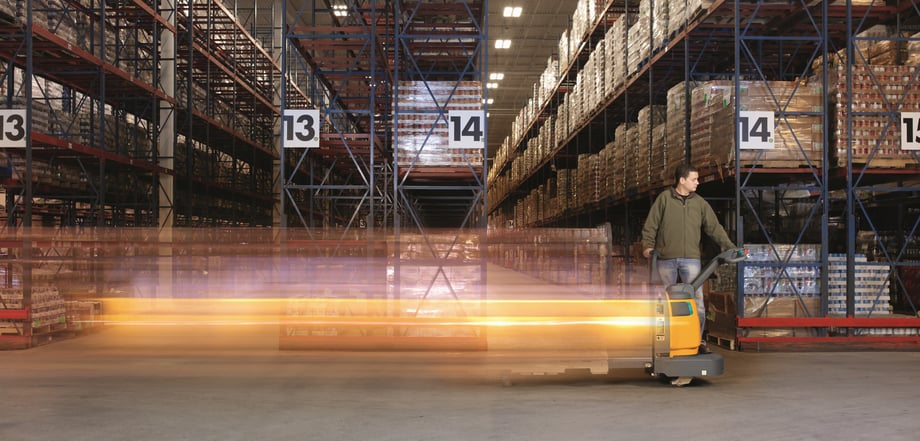
You need an electric rider pallet truck when pallet moves are long, frequent, and physically demanding enough that a walkie jack starts limiting throughput. In most operations, the tipping point shows up when operators are traveling more than 100 feet with heavy loads, moving pallets continuously for hours, or slowing down because of fatigue.
For many warehouse operations directors and managers, the real question is not whether a rider jack costs more. The real question is whether a walkie jack is still the right fit for the pace, distance, and load demands of the facility.
\## What are the signs you need an electric rider pallet truck?
There are four common tipping points:
\- Long travel distances
\- High-cycle pallet movement
\- Operator fatigue and ergonomic strain
\- More demanding dock, ramp, and trailer conditions
\## 1. When pallet travel distances exceed 100 feet
Distance is one of the clearest decision factors. A walkie jack requires the operator to stay on foot for the entire move. That works for short trips. It becomes less efficient when pallets need to move across longer warehouse lanes or between docks and staging areas.
\*\*Threshold:\*\* If operators are regularly transporting pallet loads more than 100 feet (30 meters), especially loads up to 8,000 lbs., an electric rider pallet truck deserves serious consideration.
\*\*Why it matters:\*\* A walkie jack typically moves at about 3 to 4 mph. A rider jack can reach 6 mph. That speed difference translates directly to more trips per shift and better throughput.
\## 2. When pallet movement stays constant for hours
An electric rider pallet truck makes the most sense when it stays in motion. If the truck is supporting receiving, staging, replenishment, or repeated full-pallet transport, the gain is operational and measurable.
You may be at this tipping point if:
\- Inbound pallets are moving from the dock to staging throughout the day
\- Outbound pallets are being pulled continuously for shipping
\- Operators are making repeated full-pallet moves for case picking or replenishment
\*\*ROI guideline:\*\* If the equipment sits idle for long periods, a walkie jack may still be the better fit. If it is active for 4 or more hours during an 8-hour shift, the productivity gains from an electric rider pallet truck can justify the investment much faster.
\## 3. When operator fatigue starts reducing pace and consistency
Fatigue is not just a comfort issue. It affects pace, consistency, and safety over the course of a shift. Electric walkie jacks reduce pushing and pulling compared with manual pallet jacks, but they do not eliminate the strain of continuous walking.
\*\*Why this matters:\*\* On longer routes, operators on foot tend to slow down as the shift continues. A rider jack allows the operator to stay on a cushioned platform and maintain a more consistent speed.
\*\*Operational impact:\*\* Lower physical strain can also help reduce repetitive-use injuries involving muscles and joints. That translates directly to fewer disruptions, better consistency, and more control over long-term operating costs.
\## 4. When docks, ramps, and trailer entry require more control
Heavy pallet movement across dock plates, bridge plates, and warehouse ramps requires stable braking and better load control. This is another area where an electric rider pallet truck can offer a clear advantage.
\*\*Control advantage:\*\* Rider jacks are designed for higher travel speeds and heavier loads, often with electric or regenerative braking systems that support better handling on inclines.
\*\*Visibility advantage:\*\* In an end-rider configuration, the operator has better forward visibility while traveling. In busy dock environments, that improved sightline supports safer operation.
\## How do you know if it is time to upgrade from a walkie jack?
Ask yourself these three questions:
\- Is the average travel distance for your heaviest pallet moves greater than 100 feet?
\- Are receiving, staging, or replenishment zones struggling to keep pace with demand?
\- Is operator fatigue from constant walking creating visible slowdowns or safety concerns?
If you answered yes to any of these questions, a rider jack may no longer be optional. It may be the right next step to protect throughput, reduce operator strain, and keep your operation moving efficiently.
When you are ready to compare equipment options for your facility, Equipment Depot can help you evaluate the right fit for your application. Speak with one of our experienced consultants at \*\*888.EQDEPOT\*\*.
## UPGRADE YOUR WAREHOUSE OPERATIONS
An end-rider pallet jack can significantly increase productivity and throughput in your warehouse operation, while simultaneously improving your employees work experience and safety. Our experienced team will help you determine which end-riders are right for your operation.
[](https://cta-redirect.hubspot.com/cta/redirect/2555588/fbbd33f0-a202-44d2-b304-7dc9093fdf74)
[PREVIOUS POST](https://blog.eqdepot.com/use-section-179-to-save-on-taxes-by-deducting-new-used-equipment-costs) [NEXT POST](https://blog.eqdepot.com/how-to-beat-tariff-hikes-on-forklifts-and-equipment)
**Stay ahead of the curve with material handling insights to improve
your business. Sign up for the Equipment Depot newsletter.**
### Subscribe to Equipment Depot
[BLOG](https://blog.eqdepot.com/) | CONTACT US | [LEGAL NOTICE](https://www.eqdepot.com/legal-notice/) | [PRIVACY POLICY](https://www.eqdepot.com/privacy-policy/) | [EQDEPOT.COM](https://www.eqdepot.com/)
Copyright 2016-2026. Equipment Depot, Inc. All Rights Reserved.
EQUIPMENT DEPOT, **EQUIPPED TO SERVE**, **PERFORMANCE. GUARANTEED.**, **EQ** SOLUTIONS, **EQ** ONE, FLEET **EQ**, RENTAL **EQ**, SERVICE **EQ**, PARTS **EQ** and the EQUIPMENT DEPOT logo are registered trademarks of Equipment Depot, Inc. All other trademarks are the property of their respective owners.